


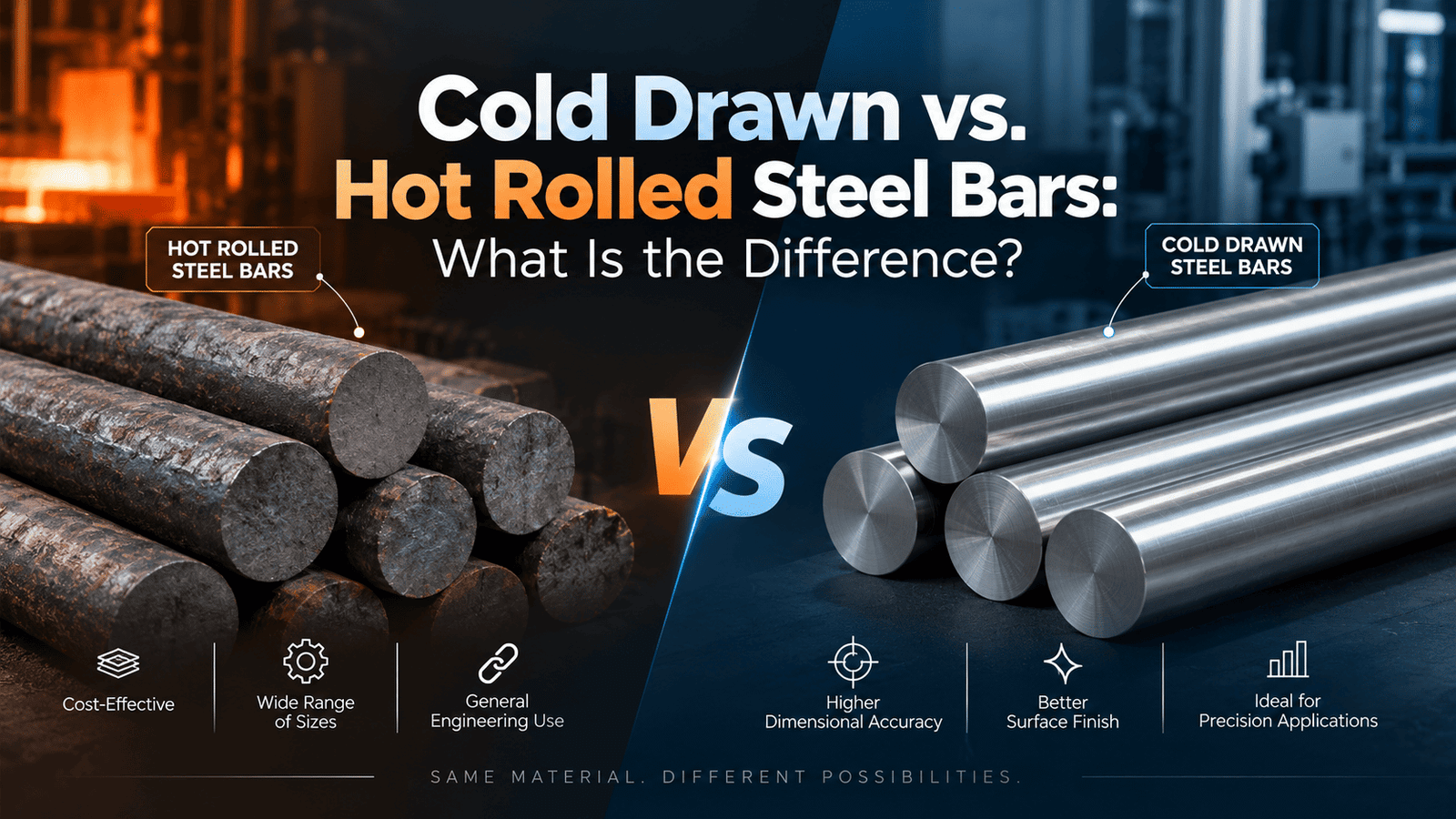
Both cold drawn steel bars and hot rolled steel bars have a wide range of applications in the fields of engineering, automobiles, machinery, and manufacturing. Even though the two have the same base material, namely steel, the major point of difference is in the manufacturing process itself.
It makes all the difference regarding their precision, surface quality, strength, machinability and uses.
What Are Hot Rolled Steel Bars?
Steel rods are manufactured by heating steel beyond its recrystallization temperature and then rolling it to produce the desired dimensions and shape.
This is because at elevated temperatures, steel becomes easy to shape and form into various sizes and shapes.
Steel rods are mostly utilized when high precision and surface finish are not the critical considerations.
Common applications include:
- General engineering components
- Construction and fabrication
- Heavy machinery
- Structural applications
- Industrial equipment
The surface of a hot rolled bar can have a scale layer formed during the high-temperature manufacturing process.
What Are Cold Drawn Steel Bars?
Cold drawn steel bars are made by drawing a steel bar through a die when the bar is at room temperature. This process reduces the cross-section area of the steel bar.
There are many benefits that cold drawing of steel may offer, which include improvements in accuracy of dimensions, finishing of surfaces, and mechanical properties.
Cold drawn bars are commonly used for:
- Automotive components
- Precision engineering parts
- Shafts
- Fasteners
- Hydraulic components
- Machine parts
They are particularly useful when manufacturers require consistent dimensions and a better surface finish.
Cold Drawn vs. Hot Rolled Steel Bars
The major distinction is in the processing temperature and finishing.
The process of hot rolling occurs at very high temperatures, which makes it ideal for manufacturing steel bars at varying sizes. The cold drawing of the steel bars occurs after the production of the steel, which offers more control on the size and quality of the surface.
In simple terms:
The hot rolled steel bars are mostly chosen for jobs that do not need any special dimensions or engineering requirements.
The cold drawn steel bars are mainly used when precision dimensions, finish, and quality are needed.
Key Differences
1. Manufacturing Process
Hot rolled bars are shaped while the steel is heated to a high temperature. Cold drawn bars are pulled through a die at room temperature to achieve the required dimensions.
2. Dimensional Accuracy
Cold drawn steel bars generally offer tighter dimensional control than hot rolled bars because the drawing process provides greater control over the final size.
3. Surface Finish
Cold drawing can produce a smoother and cleaner surface compared with the typical surface of hot rolled steel.
4. Mechanical Properties
Cold working can increase the strength and hardness of certain steel grades. However, the final mechanical properties depend on the grade, amount of cold reduction and any subsequent heat treatment.
5. Cost and Processing
Hot rolled steel is generally suitable for producing large quantities and sections efficiently. Cold drawn steel requires additional processing, which can increase manufacturing costs but may reduce the need for further machining in precision applications.
When Should You Choose Cold Drawn Steel?
Cold drawn steel bars can be a suitable choice when your application requires:
- Tight dimensional tolerances
- Consistent dimensions
- Better surface finish
- Reduced machining requirements
- Precision-engineered components
The specific steel grade and required properties should always be considered before selecting the material.
When Should You Choose Hot Rolled Steel?
Hot rolled steel bars can be suitable when the application primarily requires:
- General engineering performance
- Larger sections or dimensions
- Cost-effective material production
- Further machining or fabrication
- Applications where very tight tolerances are not essential
Which One Is Better?
Neither can there be a definitive answer as to which is better than the other – hot rolled or cold drawn steel. The correct option depends upon the component itself, its tolerance requirements, surface condition, mechanical characteristics, machining process, and the application.
In case of precision components, the use of cold drawn steel may give some edge in terms of dimension and surface condition. For engineering applications where further machining/fabrication is required, then hot rolled steel may be preferred.
Final Takeaway
The difference between cold drawn steel bars and hot rolled steel bars has everything to do with the process of manufacturing these materials.
Hot rolling is very beneficial in terms of efficient production of steel of all different sizes, but cold drawing gives more precision in dimension and surface. The selection of the material, thus, should depend on the need of the final product and not just on the material itself.
For anyone dealing with the manufacture of steel bars, an understanding of manufacturing, dimensional tolerance, surface finish, and mechanical properties of the material is very important.