


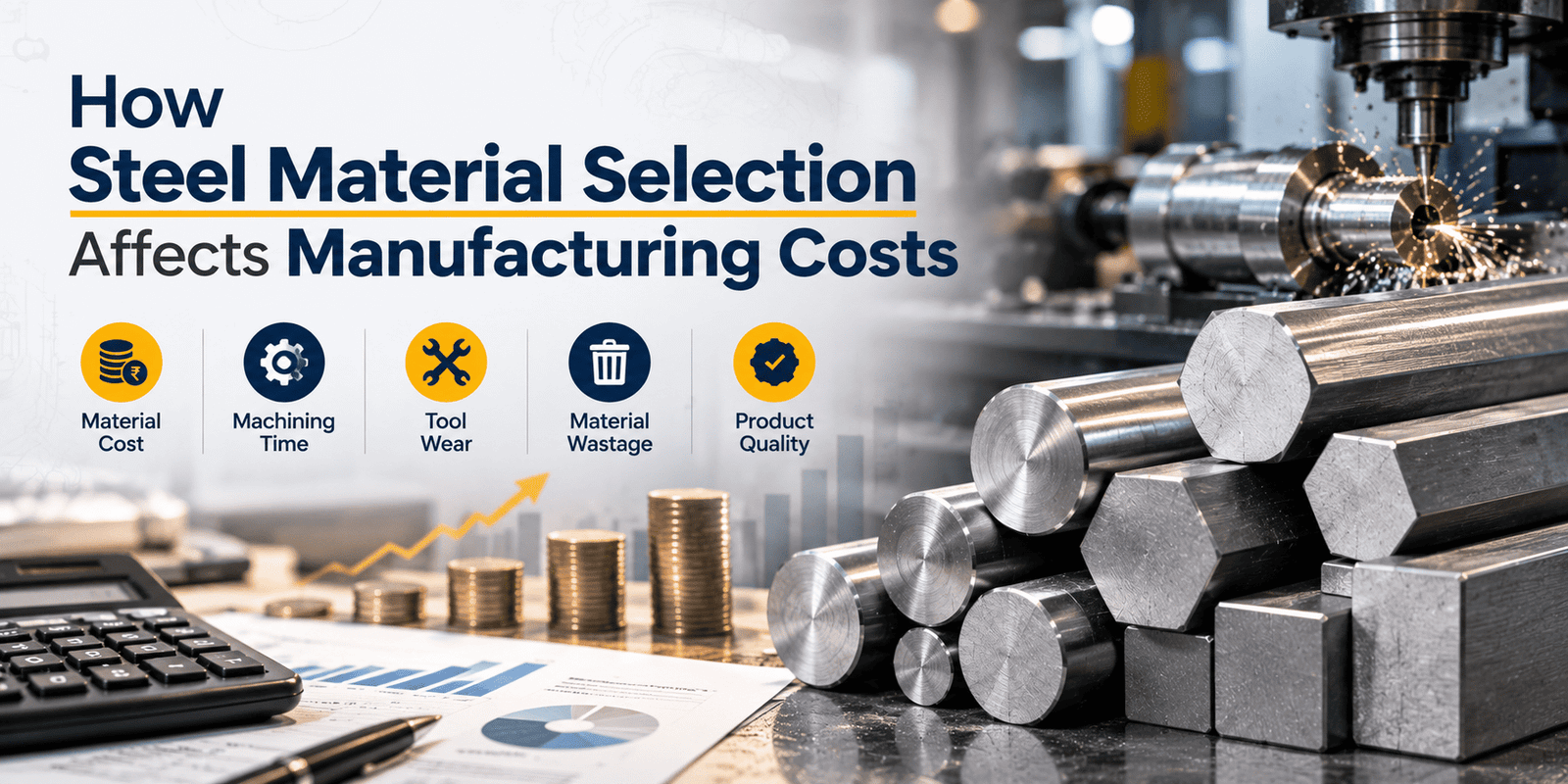
Selecting the appropriate steel material is an important step for any manufacturing company. Apart from impacting the cost of the raw materials purchased, it can impact machining time, tool life, waste material, need for finishing, quality of the end-product, and the cost of manufacture.
In the case of manufacturers of industrial fasteners, automotive parts, machine parts, and engineered products, these aspects can be quite significant.
A lower-cost steel material might appear to be economically advantageous in terms of purchase costs initially. However, if it needs further machining, frequent tool changes, or additional finishing, it will impact the cost of manufacturing adversely.
The smarter way is to choose steel that satisfies the engineering requirements of the part along with being a smart choice for manufacturing.
Why Is Steel Material Selection Important in Manufacturing?
Each one has particular performance requirements. Some require strength, some machinability, some toughness, some hardness, and some wear resistance.
Using the wrong steel grade could mean extra processing, delays in manufacturing, rejection of parts, or premature failure of the finished product.
For instance, a part used in general machinery may not have the same requirements as a part used in heavy duty automobile application. It would be unnecessary to use a more expensive alloy steel if its properties are not required for the part.
The same applies to the choice of a steel grade that does not fit the part requirements.
According to ASM International's technical guidance on materials selection and processing, material selection should be considered alongside the manufacturing process.
The goal is not simply to choose the cheapest steel. It is to find a suitable material that delivers the required performance at a reasonable total manufacturing cost.
1. Raw Material Price Influences the Production Budget
Material cost of the steel is usually the first thing that companies evaluate when they are comparing different materials.
Carbon steel may be used for many engineering purposes, whereas alloy steel would be needed in case the particular strength, hardenability, or toughness of material is required.
Nevertheless, the higher price of the material does not imply that the cost per finished part will be higher as well.
Steel grade that is cheaper can take longer to process; another steel grade will be more expensive but will help save time and effort of production.
Before placing an order, manufacturers should evaluate:
- Steel grade and required mechanical properties.
- Bar dimensions, shape, and surface condition.
- Material required for each finished component.
- Expected machining waste and usable yield.
- Additional processing and finishing requirements.
- Quality inspection and rejection risks.
Comparing these factors provides a more realistic understanding of material-related expenses.
2. Machinability Affects Production Time
Machinability is the behavior of materials when they are being machined by processes like turning, milling, drilling, and grinding. These may affect such aspects as cutting forces, chip formation, tool wear, surface finish, and manufacturing speeds.
The machinability of steel is determined by various parameters such as chemical composition, microstructure, hardness, strength, and more.
According to ASM International's resource on the machinability of steels, these characteristics are important when determining how a steel grade performs during machining.
A material that is difficult to machine under the intended production conditions may result in:
- Longer machining cycles.
- More frequent cutting tool changes.
- Increased machine operating costs.
- Additional adjustments to cutting parameters.
- Greater difficulty achieving the required surface finish.
For manufacturers producing thousands of components, even a small increase in machining time per part can affect overall production costs.
Selecting steel according to the intended manufacturing process can help control these expenses without compromising the component's required properties.
3. Tool Wear Can Increase the Cost Per Component
Cutting tools are critical in any machining process and the life span of such cutting tools affects productivity.
Different steels would exhibit varying behaviors when used in machining processes.
This would mean that depending on what type of metal is being machined and the conditions, there may be different amounts of heat produced, different levels of cutting resistance and rate of wear of the tool.
A tool that wears faster will have to be replaced faster by the manufacturer thus resulting in increased costs for tooling.
In addition, it may cause delays in the manufacturing process due to additional time being spent on replacing the worn out tools.
Apart from machinability considerations, the right steel needs to be selected and it should be tough and strong enough for its intended purpose.
4. Material Wastage Can Raise Manufacturing Costs
Material wastage is yet another key aspect that plays a role in determining the cost of manufacture of steel parts.
In the course of manufacturing, there may be wastage of material in the form of machining chips, unusable cut-offs, and rejections due to not conforming to specifications.
Wastage is influenced by the geometry of the part, initial stock sizes, precision of cutting, machining allowances, and production planning.
Selection of steel bars with appropriate dimensions may lead to reduced wastage of material. Appropriate choice of shape of the steel bars can also be helpful if the geometry of the initial shape of the part is similar to that of the final part.
For instance, the use of hexagonal steel bars will minimize the machining of six outer sides of some hexagonal components.
Read our related article on reducing material waste in steel manufacturing for further insights.
5. Steel Grade Selection Influences Heat Treatment Costs
Some parts of steel are to undergo heat treatment to develop the desirable level of hardness, strength, ductility, or abrasion resistance.
Depending on the type of steel and its use, other treatments may include hardening, tempering, or annealing. Such measures will make the production process costly due to energy usage, time used, special tools and equipment used, and tests.
The selection of proper grades of steel at the design stage will be helpful to the manufacturer to determine the needed heat treatment process.
It is necessary to confirm that the material supplied is in the proper condition before proceeding to the next step of manufacture.
Heat treatment cannot be avoided simply to cut down costs. The material characteristics must comply with the engineering standards.
6. Dimensional Accuracy and Surface Finish Matter
The state of incoming steel can affect the amount of preparation needed before manufacturing starts.
Steel rods having good dimensional tolerance, straightness, and surface finish will enable easier manufacturing planning and control.
However, dimensional deviations or surface defects may result in additional preparation, machining, and/or inspection operations.
Dimensions tolerance and straightness may be especially important in CNC machining and automatic bar feeding, as well as being related to the manufacturing process setup and stability.
Cold drawn bright steel bars may be selected where dimensions tolerance and appropriate surface finish are needed.
The correct choice of the material type is to be done in connection with component specifications and manufacturing process.
7. Welding, Forming, and Fabrication Affect Costs
Some parts made from steel need to be welded, bent, formed, or assembled instead of being machined only.
A grade of steel that is good for machining is not always the right choice for parts that need lots of welding and forming.
Depending on its composition and condition, the steel may need some further preparation or process control.
It is advisable, therefore, for manufacturers to consider the entire manufacturing process before selecting the grade of steel. This includes cutting, machining, welding, forming, finishing, and inspection.
This consideration will help avoid unnecessary costs during manufacturing.
8. Quality Control and Rejected Components Add Hidden Costs
The cost of the failed component could be significantly higher than that of the material used to produce it.
By the time the defect is discovered, the part may have gone through processes such as machining and finishing and many inspections. The manufacturer not only loses the material but also all the labor, power, tooling, and processing costs incurred.
Material selection could affect this risk as various grades and conditions of materials react differently to manufacturing and service conditions.
To minimize unnecessary quality problems, customers should check the material specifications, dimensions, certifications, and necessary inspection criteria prior to receiving the material.
While having the correct material will not ensure the elimination of all production defects, it is an ideal starting point for manufacturing.
9. Material Selection Can Affect Product Life
Production costs of manufacturing a product do not necessarily stop at its leaving the factory.
In the case of components that will be subjected to stress, friction, corrosion or difficult working conditions, the choice of the steel may affect the longevity and need for servicing of these components.
An inappropriate metal will either wear out quickly or simply not be able to stand the expected working conditions, resulting in expenses related to replacing it or repairs.
Sometimes, an elevated price of some steel grade is economically justified due to the benefits that it brings.
Businesses should consider what properties will be important for a specific product.
Looking at both production costs and lifespan allows making better choices of materials.
10. How to Calculate the Total Manufacturing Cost
One method of comparing steel materials is through calculating the cost of manufacturing the acceptable finished product.
Instead of just looking at the cost of the material alone, the costs of the production process must be considered.
Manufacturing cost per acceptable part = material cost + machining cost + tooling cost + heat treatment and finishing cost + quality control cost + overhead and rework costs.
The exact computation will vary depending on the manufacturing process, and all the material options must be compared using the same criteria.
For instance, the lower-priced steel may provide cost savings in procurement, but it may need longer machining time or more frequent tool change. The higher-priced material may cut down some of the costs mentioned above, but it does not mean that it will be more cost-efficient in every case.
It all boils down to the cost of manufacturing the acceptable finished part and meeting the specifications.
For additional guidance, refer to NIST's Manufacturing Cost Guide.
11. Practical Ways to Reduce Steel Manufacturing Costs
Better material decisions could be achieved using a number of practical steps.
Determine the component requirements: Determine the required strength, environment, size, finish, and anticipated lifespan.
Compare the proper grades: Pick the material according to its properties and not because it happens to be the cheapest or the strongest.
Take into consideration the manufacturing method: Consider whether the steel is good for machining, welding, forming, and heat treatment.
Choose appropriate bar sizes: Proper sizes and shape of stock bars could be of help to avoid machining and unnecessary wastes.
Calculate the total manufacturing cost: Consider tooling, manufacturing, inspection, and possible rework in addition to comparing raw material cost.
Ensure that the material is of the required quality: Ensure that the material meets its grade, size, material condition, and proper documentation.
Check manufacturing outcomes: Monitor machining time, tool life, and rate of scrap and rejections.
How Hindustan Industrial Steels Supports Industrial Manufacturing
Hindustan Industrial Steels, operating out of Ludhiana, Punjab, provides industrial steel rods in varied cross-sections like round, square, hexagonal, flat, and other section types.
The correct choice of material, size, and surface finish is essential for buyers to suit the incoming steel bars to the manufacturing needs.
For whatever purpose the steel may be needed, whether for industrial fasteners, machining, automotive, or engineering applications, buyers must specify the grade, sizes, materials, and applications while quoting.
Visit Hindustan Industrial Steels to explore the company's steel products and discuss your material requirements.
Conclusion
Steel material selection affects manufacturing costs at every stage, from raw material purchasing to machining, finishing, inspection, and product performance.
A lower purchase price does not always translate into a lower cost per finished component. Machinability, tool wear, material wastage, heat treatment, dimensional accuracy, and quality requirements all influence the final calculation.
Manufacturers can make better decisions by evaluating these factors together and selecting steel that meets the component's actual engineering needs.
The most cost-effective material is not necessarily the cheapest steel or the highest-grade option. It is the material that delivers the required performance while supporting an efficient and economical manufacturing process.
Frequently Asked Questions
1. How does steel material selection impact manufacturing costs?
It affects raw material cost, machining time, tool wear, material wastage, finishing, inspection, and the service life of the manufactured part.
2. Does cheaper steel always save on manufacturing costs?
No. Cheaper steel might increase manufacturing cost if it needs additional machining, processing, tooling, or reworking.
3. How can machinability impact manufacturing cost?
Machinability might affect manufacturing speed, tool life, machining conditions, surface quality, and machine usage.
4. Which steel grade is the most economical in terms of manufacturing costs?
There is no universal answer to this question. It depends on required properties, part design, manufacturing process, and specifications.
5. How can manufacturers decrease steel material wastage?
They can choose proper bar shape and size, plan cutting efficiently, minimize unnecessary machining allowances, and control scrap rate.
6. Why is dimension consistency an important factor while buying steel bars?
Dimension consistency allows simplifying production setup and decreasing unnecessary preparations.
7. Should manufacturers take into account product life cycle while choosing steel?
Yes. Steel strength, toughness, wear resistance, fatigue resistance, and corrosion resistance may influence maintenance and replacement cost.
8. What should buyers check before ordering industrial steel bars?
Confirm the steel grade, dimensions, tolerances, surface finish, material condition, applicable standards, and relevant material certificates.