


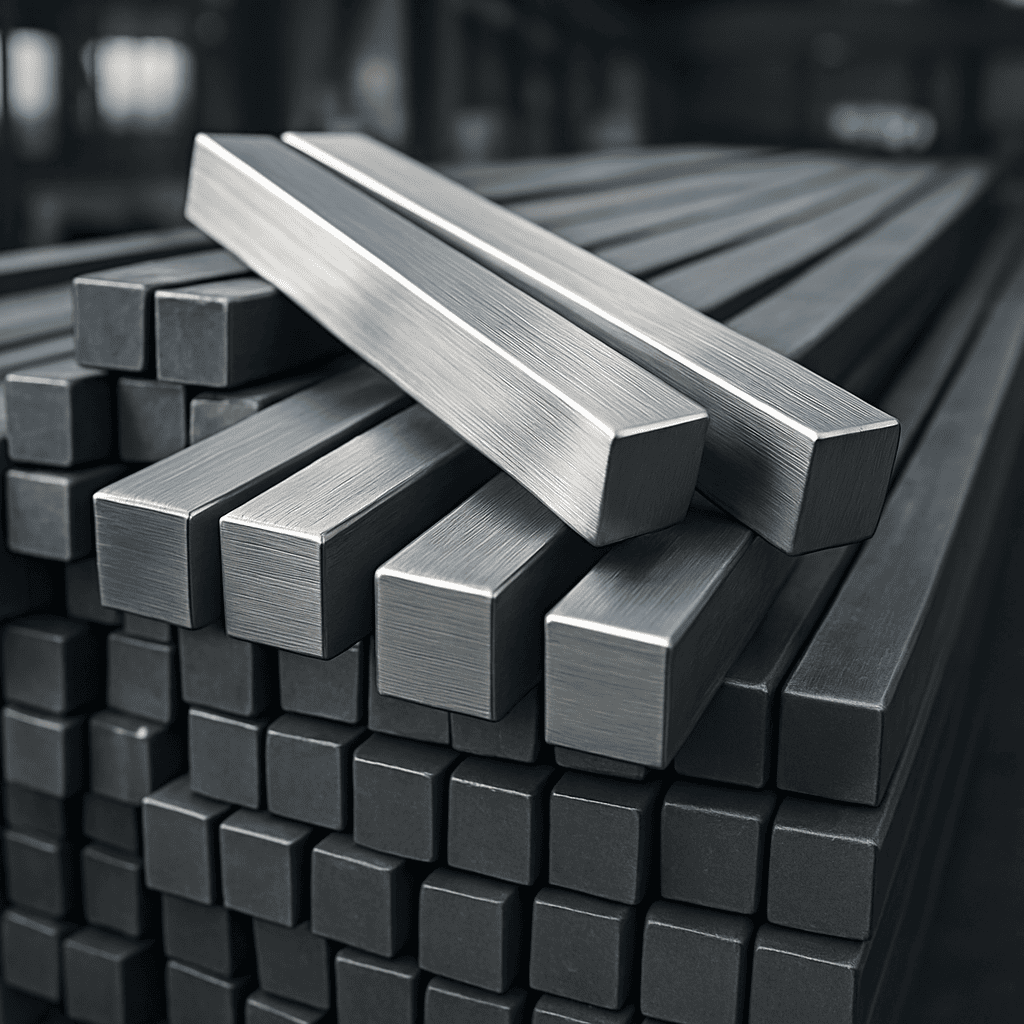
Square bright bars are widely used in precision machining, jigs, fixtures, support blocks, and industrial fabrication. Below are common questions buyers ask when selecting square bright bars for production.
As a square bright Bars manufacturer, we answer these daily based on real workshop and CNC floor requirements.
1. What are square bright bars?
Square bright bars are cold-finished steel bars with equal-sided dimensions and a smooth, accurate surface. They offer tight tolerances, sharp corners, and straightness suitable for precision machining and fabricated components.
2. How are square bright bars manufactured?
These bars are produced through processes like cold drawing, peeling, or centreless grinding. The bar is drawn through a die to achieve accurate shape, followed by finishing to improve surface quality and dimensional accuracy.
3. Where are square bright bars used?
Common applications include:
- Machine tool fixtures
- Support blocks and base plates
- Fabrication frames and brackets
- Industrial automation equipment.
- Structural inserts and alignment guides
Tool rooms and CNC workshops frequently choose this profile for projects needing flat faces and clean edges.
4. Why choose square bright bars over hot rolled square bars?
Square bright bars provide:
- Better size accuracy
- Improved surface finish
- Superior straightness
- Reduced machining effort
- Lower tool wear
Hot rolled bars are suitable for heavy fabrication, while bright bars are preferred for precision components.
5. What steel grades are available in square bright bars?
Depending on application load and machining requirements, square bright bars are available in:
- Mild steel (MS)
- Carbon steel grades
- Alloy steels (EN series, SAE series)
- Stainless steel grades
Selection is generally based on strength, wear resistance, and corrosion needs.
6. What tolerances can be expected?
Typical tolerances follow industry standards for cold-finished bars, allowing consistent sizing for CNC operations. For tight tolerance applications, custom finishing and inspection standards can be offered.
7. What sizes are commonly supplied?
Standard square bright bars range from small tool-room sizes to large industrial cross-sections. Custom dimensions are available based on production requirements and machine compatibility.
8. Why source from a specialist manufacturer?
A dedicated square bright Bars manufacturer ensures:
- Dimensional consistency across batches
- Controlled straightness
- Defect-free corners and edges
- Reliable machinability
This reduces machining time and improves productivity for workshops and assembly lines.
Conclusion
Square bright bars are an essential raw material for accuracy-driven industries. When chosen properly, they minimize machining effort, enhance component precision, and support long-term performance in mechanical systems.
For engineering guidance, grade suggestions, or size recommendations, you can consult our technical team anytime.