


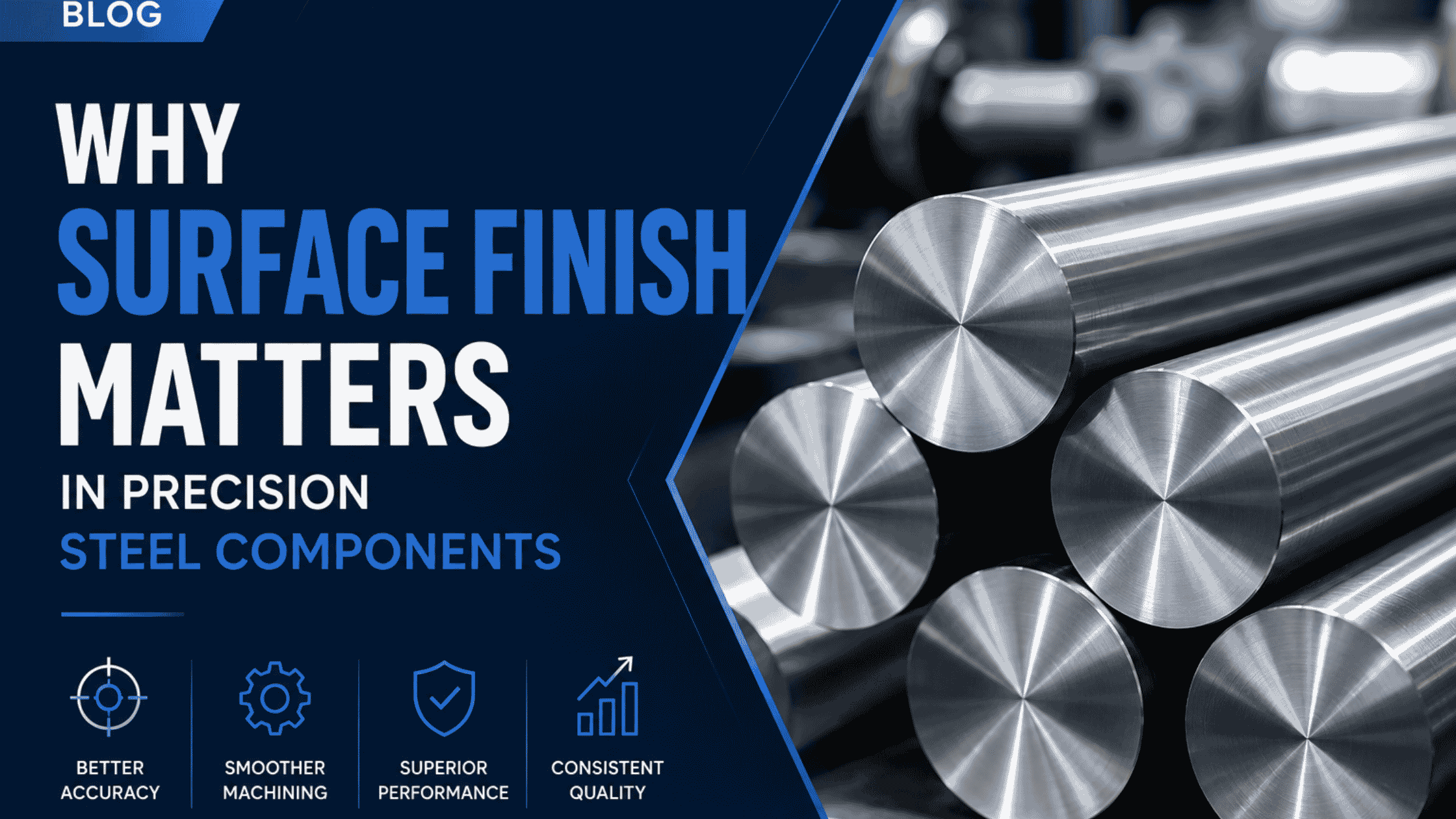
For manufacturing a precision component, the correct choice of steel grade is essential. However, the surface condition of the steel bar is just as crucial.
The condition of the surface may influence the machining process, the dimensions of the part produced, its appearance, and even its performance. That is the reason why industries that produce shafts, pins, fasteners, and machine components prefer bright steel bars to hot-rolled bars.
What Is Steel Bar Surface Finish?
Surface finish refers to the state of the surface of a steel rod once the production process is complete.
Processes like cold drawing, turning, grinding, and polishing enhance the surface finish and dimensional accuracy of the bar. Cold drawing also results in the formation of new shapes and dimensions of the rod without any material removal. The process of grinding, however, removes some material to enhance surface finish and dimensional accuracy.
The finish needed will depend on the part and its manufacturing process. This does not necessarily mean that a higher finish is better in all cases.
Why Does Surface Finish Matter?
1. It Supports Better Machining
A consistent surface and controlled dimensions can make machining more predictable. This can be particularly useful for CNC machining and the production of precision components.
2. It Helps Maintain Dimensional Accuracy
Precision parts may have to interact with other parts where even slight dimension differences can make a difference. Precision-machined cold-drawn, ground, and polished rods may be better dimensionally controlled than plain hot-rolled bars.
3. It Can Reduce Extra Machining
Where the supplied bar comes closer to the right specifications and dimensions, it may mean that less machining will have to be done on the workpiece.
4. It Improves Surface Quality
Grinding and polishing can produce a cleaner and more uniform surface. This is useful when the finished component requires a controlled appearance or surface condition.
Which Finish Should You Choose?
There is no universal type of finish for all components.
Cold drawn bars are preferred where dimensional accuracy, straightness, and surface condition matter. Ground bars are recommended where there is the need for greater accuracy and a better surface condition.
This decision needs to be made taking into consideration the drawing of the component, the tolerance and the machining process of the component.
For instance, Hindustan Industrial Steels provides round bright bars in the form of cold drawn & polished as well as cold drawn & ground types, in sizes ranging from 2 mm to 100 mm (ground) and 5 mm to 100 mm (cold drawn & polished).
What Should You Check Before Buying?
Before selecting a steel bar, look beyond the appearance. Check:
- Steel grade
- Bar diameter and tolerance
- Required surface finish
- Straightness requirements
- Manufacturing standard
- End condition and required length
- Application and machining process
These details help ensure that the material you purchase is suitable for the component you are producing.
Choosing the Right Manufacturer
The production method directly affects the consistency of the end product. A dependable round bright bar manufacturer must be able to talk about the grade, size, tolerance and finish that you need, not just supply a standard bar.
Hindustan Industrial Steels manufactures industrial steel products including bright bars in round, square, hexagonal, flat and special sections. Its manufacturing processes include cold drawing, turning/peeling and grinding, with products offered according to agreed sizes, tolerances and applicable Indian or international standards.
Final Takeaway
Surface finish is not just about making a steel bar look smooth. It can influence dimensional control, machining requirements and the suitability of the material for precision components.
Before choosing a bright bar, match the steel grade, size, tolerance and surface finish to the actual application. That simple step can help improve manufacturing consistency and avoid unnecessary machining work.