


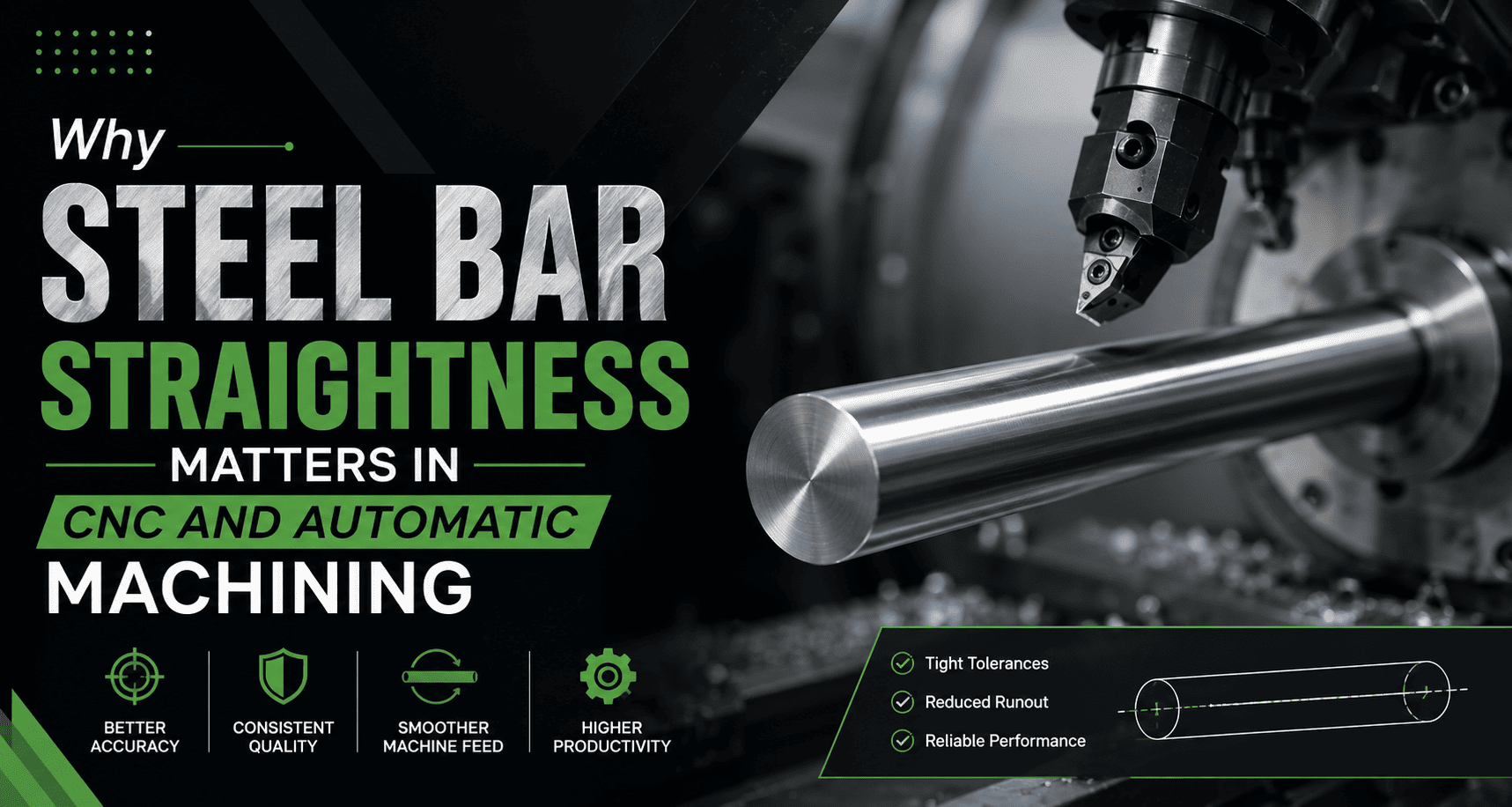
When a steel bar enters a CNC machine, most attention naturally goes toward its grade, diameter, hardness and dimensional tolerance. But there is another specification that can have a major impact on machining performance: straightness.
A steel bar might have the right diameter but yet still cause problems if it has too much bow or deviation on the length of the bar. In the case of CNC turning, automation and bar feeding, the bar will have to move, rotate, and position itself continuously during the entire manufacturing process.
In situations where many bars are being manufactured on a daily basis, even a small problem on the bar may end up becoming a serious manufacturing issue.
It is for this reason that steel bar straightness cannot be considered a secondary specification when selecting the right material for machining.
What Does Steel Bar Straightness Actually Mean?
Straightness in steel bars relates to how much the bar conforms to a straight line over its length.
For a practical illustration, consider a steel bar placed on a very flat surface. For the straight bar, there is consistency in terms of alignment. For curved bars, there will be deviation from the straight line.
Deviation levels are dependent on factors such as the material, size, production environment, standard being followed, and the intended application of the steel bars.
It is also important to understand that straightness and dimensional tolerance are not the same thing.
For instance, although the tolerance requirements are met regarding the diameter of the bar, the amount of curvature can be too great. That is why steel buyers must take into consideration other things apart from the diameter when buying steel for automatic machining.
Why Is Straightness Important in CNC Machining?
The CNC machine is built for controlled and repeatable movement of parts. If the feedstock isn’t straight enough, this process becomes hard.
Crooked or curved bar can affect how the piece of material will be held by the chuck, collet or bar feed. Depending on the particular use, it can cause runout, vibration, unequal material removal and non-uniform machining conditions.
Sometimes this issue does not show right away. The part can pass through several stages of inspection before any issues appear in the course of longer machining operation.
Therefore, the quality of the feedstock has an immediate relationship with the quality of the machined part.
1. Better Workholding and Positioning
In CNC Turning, workholding must be reliable and repeatable.
Where there is a straight bar, it can easily be oriented in the chuck or collet. Any bowing of the bar, however, will make orienting harder, especially when the length of stock increases.
In Automatic Machining, where material is oriented without a human operator having to do corrections every time, consistency is more critical.
Consistency in incoming straightness will thus help ensure that the starting point is reliable for the machining process.
2. Reduced Runout During Machining
Runout describes the amount by which a rotating component or workpiece deviates from its intended rotational axis.
When bar stock is not sufficiently straight, the relationship between the material and the machine's rotational axis can become more difficult to control.
This matters particularly when manufacturing shafts, pins, bushes and other cylindrical components where concentricity and dimensional accuracy are important.
A better-controlled raw material helps the machining process begin with fewer variables.
3. More Consistent Material Removal
During turning, the cutting tool removes material from the workpiece according to the programmed geometry.
If the incoming bar has significant variation in its position or alignment, the cutting conditions can become less consistent.
This can affect:
- Material removal
- Cutting stability
- Surface finish
- Dimensional consistency
- Cycle-to-cycle repeatability
The impact depends on the machine setup, bar dimensions, material grade and machining operation, so straightness should always be considered alongside the complete machining requirement.
4. Lower Risk of Vibration and Poor Surface Finish
Vibration is one of the common enemies of precision machining.
An unstable workpiece can contribute to chatter or inconsistent cutting conditions. In a production environment, this can show up as poor surface finish, tool marks or variation between components.
Straightness alone does not eliminate vibration—machine rigidity, tooling, cutting parameters, workholding and material properties all matter—but controlling the geometry of the incoming bar removes one potential source of instability.
For manufacturers working with tight surface-finish requirements, that can be valuable.
5. Improved Automatic Bar Feeding
Automatic bar feeders are designed to continuously supply material to CNC machines with minimal manual intervention.
This makes raw-material consistency particularly important.
A bar that is significantly bowed can be more difficult to feed smoothly through the equipment. In some applications, excessive deviation may increase the possibility of feeding interruptions, vibration or inconsistent positioning.
For high-volume production, even small interruptions can add up.
Consider a production line manufacturing hundreds of components per shift. If operators repeatedly need to stop the machine, adjust the material or investigate feeding problems, the resulting downtime can become more expensive than the original difference in raw-material cost.
This is why straightness becomes especially relevant when selecting steel bars for automatic machining.
6. Helps Maintain Production Consistency
One of the biggest advantages of CNC machining is repeatability.
Once the machine is properly programmed and set up, manufacturers expect it to produce component after component within the required specifications.
However, CNC equipment can only control the machining process. It cannot completely compensate for every variation in the incoming raw material.
If one batch of steel behaves differently from another because of variations in geometry, surface condition or material properties, production consistency can suffer.
Using appropriately specified bright bars can help reduce some of this variation before the material reaches the machine.
Straightness Is Not the Same as Surface Finish
These two specifications are often discussed together because both can improve with certain finishing processes, but they describe different characteristics.
Straightness concerns the geometric alignment of the bar along its length.
Surface finish concerns the texture and condition of the material's surface.
A bar can have a smooth surface but still have excessive bow. Likewise, a straight bar may require additional finishing if the application demands a particular surface condition.
For precision machining, buyers should therefore consider straightness, dimensional tolerance and surface finish as separate requirements.
How Are Bright Bars Made Suitable for Precision Machining?
Different finishing processes can be used depending on the required material condition and application.
Cold drawing is commonly used to improve dimensional accuracy and produce a bright surface. Additional processes such as centreless grinding can further improve dimensional control and surface characteristics.
Hindustan Industrial Steels describes its cold-drawn bright bars as being produced from hot-rolled bars or wire rod coils using cold drawing and centreless grinding, with improved dimensional accuracy, straightness and surface quality.
The appropriate process ultimately depends on the steel grade, required size, tolerance, surface requirements and intended application.
What Should CNC Manufacturers Check When Buying Steel Bars?
Straightness should be considered as part of a larger material specification rather than evaluated on its own.
Before placing an order, manufacturers should consider:
1. Steel Grade
Choose a grade that matches the mechanical and manufacturing requirements of the component.
2. Bar Diameter or Section
Confirm the required nominal dimensions and dimensional tolerance.
3. Straightness Requirement
Specify the straightness requirement when the application involves automatic feeding, long components or precision machining.
4. Surface Condition
Determine whether a cold-drawn, peeled, ground or other surface condition is appropriate.
5. Length
Longer bars can have different handling and feeding requirements, so the required length should be considered during material selection.
6. Applicable Standard
Make sure the material specification and inspection requirements are clearly agreed between the buyer and supplier.
7. Material Documentation
For critical applications, manufacturers may also require material test certificates and inspection documentation to maintain traceability.
Which Applications Benefit Most From Better Straightness?
Straightness becomes increasingly important as machining requirements become more demanding.
Typical applications can include:
- CNC-turned components
- Automatic screw-machine components
- Precision shafts
- Pins and bushes
- Automotive components
- Power-transmission components
- Hydraulic and engineering components
- Agricultural machinery components
- Railway components
- High-volume production parts
The exact straightness requirement should always be determined according to the component design, machine setup and applicable material specification rather than using one universal value for every application.
Why Straightness Can Affect Your Overall Manufacturing Cost
The purchase price of a steel bar is only one part of the total manufacturing cost.
Suppose inexpensive raw material creates frequent feeding problems, additional setup work, increased tool wear or higher rejection rates. The apparent saving on the material can quickly disappear elsewhere in the production process.
On the other hand, material that is appropriately specified for the machining process can help reduce unnecessary preparation and improve production consistency.
This does not mean that the straightest possible bar is always the best or most economical choice.
The better approach is to specify the level of straightness that your application actually requires.
Over-specifying the material can increase purchasing costs without providing a meaningful production benefit. Under-specifying it can create problems once the material reaches the machine.
The goal is to find the right balance.
Straightness Should Be Considered Before the Material Reaches the Machine
By the time a machining problem appears in a finished component, it can be difficult to identify the original cause.
The issue could be tooling, machine alignment, cutting parameters, workholding, material hardness—or the incoming bar itself.
Checking raw-material specifications before production begins can help prevent some of these problems.
For CNC manufacturers, this means looking beyond the basic question of:
“Is the bar the correct size?”
A better question is:
“Is this bar specification suitable for the way we are going to machine it?”
That small change in the purchasing approach can make a significant difference in production environments where consistency matters.
Final Thoughts
Steel bar straightness may not be the first specification that comes to mind when selecting raw material, but it can play an important role in CNC and automatic machining.
Good straightness can support more consistent workholding, smoother material feeding and predictable machining conditions. Combined with appropriate dimensional tolerances, surface quality and material properties, it helps create a more reliable starting point for precision manufacturing.
For manufacturers producing components at scale, the objective should not simply be to purchase steel bars that meet a basic dimensional requirement. The material should be selected according to the demands of the entire machining process.
The right steel bar is not just about the steel grade or diameter—it is about how reliably the material performs once it reaches the machine.
Frequently Asked Questions
What is straightness in a steel bar?
Straightness refers to the amount a steel bar deviates from an ideal straight line along its length.
Why does straightness matter in CNC machining?
Poor straightness can make workholding, positioning and automatic feeding more difficult and may contribute to runout, vibration and inconsistent machining conditions.
Are straightness and dimensional tolerance the same?
No. Dimensional tolerance controls the size of the bar, while straightness controls its geometric deviation along its length.
Are bright bars suitable for CNC machining?
Bright bars are commonly used for precision machining because finishing processes such as cold drawing and grinding can provide improved dimensional accuracy and surface characteristics. The appropriate bar condition depends on the specific machining application.
What should I specify when ordering steel bars for CNC machining?
Consider the steel grade, section and dimensions, dimensional tolerance, straightness, surface condition, length, applicable standards and required documentation.